A lot of people put real thought into the food they buy: fresh vegetables, quality proteins, whole grains. Far fewer stop to think about what happens to all that nutrition once it hits the pot or pan. Yet the cookware you use every day has a direct effect on how much of that goodness actually survives to reach your body. Pure clay cookware offers a gentler, cleaner way to cook, one that helps preserve nutrients, avoids introducing chemicals, and treats your food with the care and respect it deserves.
In this article, we’ll look at what sets pure clay cookware apart from conventional cookware, how it helps retain the vitamins and minerals in your food, why non-toxic cookware matters for healthy cooking, and how pure clay compares to stainless steel, cast iron, and nonstick pans.
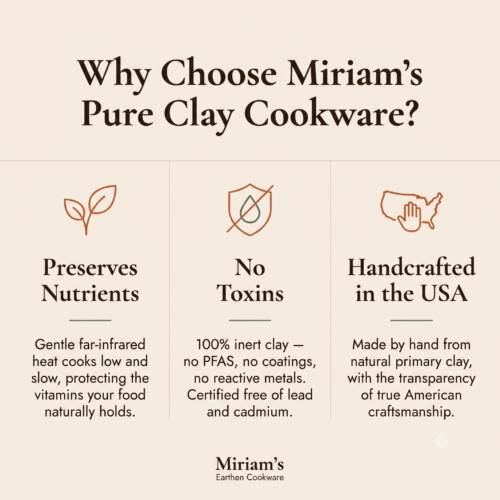
What Makes Pure Clay Cookware Different From Conventional Cookware?
The difference starts with the material itself. Most modern cookware is engineered from metals and synthetic compounds, while Miriam’s clay cookware is thoughtfully crafted fired pure earth, and that distinction shapes everything about how it cooks and what it does (or doesn’t) add to your food.
Pure Clay vs. Metal and Synthetic Cooking Materials
Conventional cookware is typically made from aluminum, stainless steel, or metal coated with synthetic non-stick layers. These materials are prized for being cheap to produce and fast to heat, but they are also reactive, and often coated or alloyed with substances that reactively leach into food. Pure clay is fundamentally different: it is a natural, non-reactive material that stays completely inert during cooking. It has no coatings to scratch, no glaze chemistry to question, and nothing synthetic that can migrate into your meal.
The Natural Benefits of Earthen Cookware
Earthen cookware has been used across cultures for thousands of years, and for good reason. Miriam’s clay cooks with a gentle, radiant heat that surrounds food evenly, holds moisture beautifully, and brings out deep, natural flavor. Because it is unglazed and inert, it adds nothing to your food, no metallic taste, no coating particles, just clean cooking. Over time, Miriam’s pure clay pots and pans naturally season with use, becoming more non-stick the more you cook with it.
Why More Consumers Are Choosing Non-Toxic Cookware
Awareness around non-toxic cookware has grown quickly as more families learn what conventional pots and pans can contain. Concerns about PFAS “forever chemicals” in non-stick coatings, reactive metals, and undisclosed glaze compounds have led health-conscious home cooks to seek out safer, more natural alternatives. Pure clay cookware answers that demand directly: it is chemical-free, non-reactive, and made from a single natural material you can actually understand.
How Pure Clay Cookware Helps Preserve Nutrients Naturally
One of the most compelling reasons to cook in clay is nutrient retention. The way food is heated has a real effect on how much of its nutrition survives, and pure clay’s gentle approach is uniquely suited to protecting it.
The Impact of conventional Heat on Vitamins and Minerals
Many of the nutrients that make whole foods valuable are sensitive to heat. Water-soluble vitamins like folate and vitamin C are especially fragile, they degrade quickly when cooking with the damaging near-infrared heat produced by conventional metal and ceramic pots. and dissolve easily into cooking water, while delicate healthy fats can oxidize under aggressive heat. Because these compounds are so vulnerable, the way you cook can have a real effect on how much of them actually survives to nourish you.
Research on home cooking bears this out. A review of cooking methods for vegetables, potatoes, and pulses found that the effect of cooking on nutritional quality varies considerably depending on both the method used and the specific nutrient involved, with cooking approaches that limit exposure to high heat and water generally helping to better retain the most heat-sensitive nutrients. In practical terms, gentler cooking tends to preserve more of the good stuff.
That’s where healthy cookware comes in. Metal cookware heats fast and concentrates that heat into intense hot spots, which can be hard on fragile, heat-sensitive nutrients. Cooking at lower, gentler, more even temperatures is one of the simplest ways to protect the vitamins and minerals in your food, and it’s exactly the kind of cooking in Miriam’s pure clay is made for.
Even Heat Distribution and Gentle Cooking
Pure clay radiates gentle far-infrared heat evenly from all directions, rather than concentrating it on a single hot surface. This means food cooks thoroughly at lower effective temperatures, without the scorching hot spots that break down heat-sensitive vitamins. It’s a gentler approach, and gentler cooking genuinely matters for nutrition: research comparing cooking methods has found that gentle, water-based cooking like steaming tends to preserve antioxidants and vitamin C better than harsh, high-heat methods such as frying. The result is food that comes out tender and cooked through while holding on to more of its natural nutrition, exactly what you want from cookware built for nutrient retention.
Steam-Locking Properties That Support Nutrient Retention
Miriam’s clay pots have been designed with the remarkable ability to hold and circulate moisture as they cook. One way this is accomplished is by facing the clay platelets on the inside of the pot in downwards in spirals. As food heats, the snug-fitting clay lid and the pot’s naturally moisture-retaining walls create a warm, steam-rich environment inside, gently trapping the moisture that would otherwise escape from an open metal pan. Rather than letting steam, and the water-soluble nutrients it carries, evaporate away, the clay keeps it circulating around your food, continually basting it in its own natural juices.
This gentle, moisture-locked cooking does two important things for nutrition. It keeps food tender and prevents it from drying out, and it helps preserve the water-soluble vitamins, like folate and vitamin C, that are so easily lost when moisture boils off or gets poured down the drain with the cooking water. The result is food that stays succulent and holds on to more of the goodness you started with, cooked gently in an environment the clay itself creates.
.
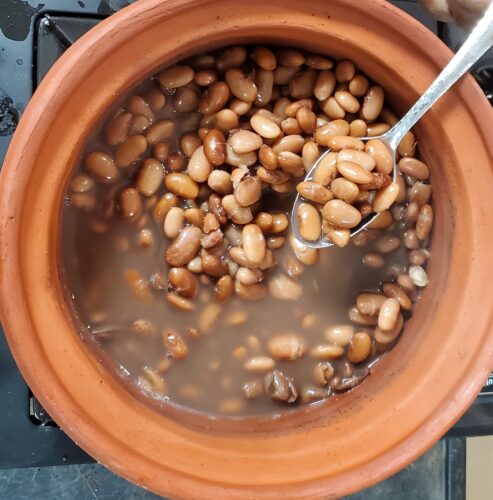
Why Non-Toxic Cookware Is Essential for Healthy Cooking
Preserving nutrients is only half the equation. Truly healthy cooking also means making sure your cookware isn’t adding anything harmful to your food in the process.
Understanding Lead-Free and Chemical-Free Cookware
“Lead-free” is a term worth understanding closely, because it does not always mean what shoppers assume. A great deal of cookware sold today is manufactured overseas, often in facilities where testing is also conducted, under regulatory standards that can be looser than those in the United States. Under current marketing rules, a product can be labeled “lead-free” as long as any lead content falls below a defined regulatory threshold, such as California’s Proposition 65 limits, rather than meaning zero lead is present.
The concern is real, not hypothetical. The FDA notes that lead can leach into food from cookware and traditional pottery, and because there is no known safe level of lead exposure, it monitors and regulates lead in the food supply. In fact, in 2025 the FDA issued a safety warning urging retailers and consumers not to sell or use certain imported cookware found to leach significant levels of lead into food, initiating recalls of numerous products, with young children and pregnant or nursing women identified as most at risk.
This is exactly why sourcing and testing transparency matter so much. Miriam’s Earthen Cookware is made in the USA and is tested and certified free of lead and cadmium, giving families confidence in what they are, and are not, cooking with. With pure, unglazed clay, there is no glaze chemistry to question and no imported supply chain to wonder about, just natural clay and gentle heat.
Avoiding Unwanted Contaminants During Cooking
Beyond lead, conventional cookware can introduce other unwanted substances during cooking. Scratched non-stick coatings shed particles and release fumes, reactive metals like aluminum can leach into both acidic and basic foods, and stainless steel can transfer nickel and chromium under prolonged heat. Cast iron is known to transfer iron into food during cooking, research has shown that most foods cooked in iron cookware absorbed significantly more iron than those cooked in non-iron cookware, with acidic, moisture-rich foods absorbing the most. It’s a clear example of how a reactive cooking surface becomes part of the meal. Miriam’s pure clay works differently: because it’s completely inert, nothing transfers from the pot into your food, no metals, no reactive compounds, nothing but gentle heat.
Choosing the Healthiest Cookware for Your Family
When you’re cooking for the people you love, day after day, the cookware becomes part of the meal. Choosing the healthiest cookware means choosing a material that contributes nothing but gentle heat, no coatings, no reactive metals, no mystery compounds. For many families, pure clay has become the clear answer: a single, natural material with a long, trusted history and nothing to hide.
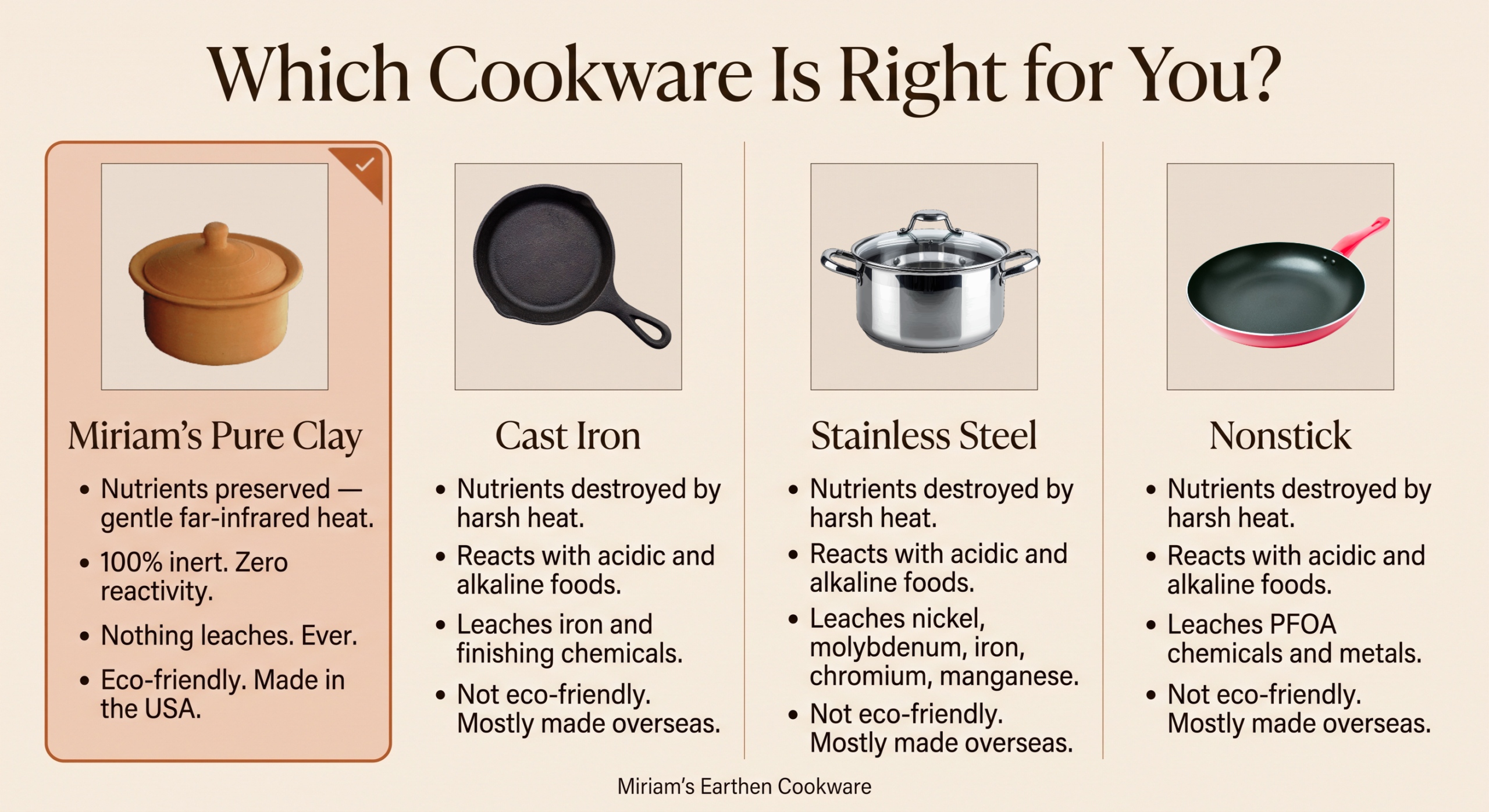
Pure Clay Cookware vs. Stainless Steel, Cast Iron, and Nonstick Pans
How does pure clay actually stack up against the cookware most people already own? Each material has its place, but for nutrient retention and clean cooking, the differences are meaningful.
Comparing Nutrient Retention Across Cookware Types
Stainless steel is stable and durable but heats aggressively and unevenly, which can be hard on delicate nutrients. Cast iron holds heat well and is beloved for searing, but it also cooks at high temperatures and can react with acidic foods. Nonstick pans cook at lower temperatures but rely on synthetic PTFE coatings that can degrade when overheated or scratched. Pure clay offers gentle, even, moisture-rich heat with no coatings at all, making it especially well suited to preserving the vitamins and minerals in your food.
Heat Transfer and Cooking Performance
Metal cookware transfers heat quickly and intensely, which is useful for fast searing but tough on heat-sensitive nutrients and prone to hot spots. Pure clay works differently: it heats gradually and radiates warmth evenly from every direction, cooking food thoroughly and gently. Once hot, clay retains and distributes that heat beautifully, giving you tender, evenly cooked results with far less risk of scorching.
Which Cookware Is Best for Health-Conscious Home Cooks?
For health-conscious home cooks focused on nutrition and clean cooking, Miriam’s pure clay stands out. It combines gentle nutrient-preserving heat with a completely non-toxic, non-reactive surface, something no coated or metal cookware can fully offer. For everyday cooking of the wholesome meals your family relies on, it’s a genuinely compelling choice.
Why Handmade, Made-in-USA Pure Clay Cookware Is Worth the Investment
Not all clay cookware is created equal, and where and how it’s made matters just as much as the material itself.
The Value of American-Made Craftsmanship
Miriam’s Earthen Cookware is handcrafted in the USA from domestically sourced primary clay, made in small batches and finished by hand burnishing without any toxic glaze. American-made craftsmanship means transparency in how the cookware is sourced, made, and tested, an assurance you don’t get from mass-produced imports. When you invest in handmade cookware from the USA, you know exactly what you’re bringing into your kitchen.
Sustainability and Eco-Friendly Benefits
Pure clay is one of the most naturally sustainable cookware materials available. It’s made from a renewable, abundant natural resource, requires no synthetic coatings or chemical processing, and because it retains heat so efficiently, it can use less energy to cook than poorly-retaining metal cookware. From sourcing to daily use, it’s a gentler choice for the planet as well as your family.
Better Cooking, Better Nutrition, Better Health
Ultimately, choosing handmade, made-in-USA pure clay cookware is an investment in the way you cook and eat every day. Gentler cooking preserves more of your food’s nutrition, an inert surface keeps unwanted substances out of your meals, and a naturally beautiful, time-tested material turns everyday cooking into something a lot more intentional. Better cooking really can mean better nutrition, and better nutrition supports better health.
Frequently Asked Questions About Pure Clay Cookware
Does Pure Clay Cookware Preserve More Nutrients?
Yes. Because pure clay cooks with gentle, even far-infrared heat at lower effective temperatures and holds moisture well, it helps protect the heat-sensitive vitamins and minerals that aggressive high-heat metal cooking tends to destroy. Its moisture-rich cooking environment also helps retain water-soluble nutrients that can otherwise be lost.
Is Pure Clay Cookware Truly Non-Toxic?
Pure, unglazed clay cookware is one of the most genuinely non-toxic options available. Miriam’s Earthen Cookware is made from 100% primary clay, is completely inert, and is tested and certified free of lead and cadmium, with no PFAS, no synthetic coatings, and no reactive metals. There is nothing to leach into your food!
Can Pure Clay Cookware Be Used Every Day?
Absolutely. Pure clay cookware is designed for everyday cooking. It becomes more naturally non-stick as it seasons with use, handles everything from grains and stews to soups and vegetables, and only gets better the more you cook with it.
What Foods Taste Best When Cooked in Clay Pots?
Clay excels at slow-cooked, moisture-rich dishes: soups, stews, beans and lentils, rice and whole grains, braised vegetables, and one-pot meals all come out especially tender and flavorful. Because clay retains moisture and cooks gently, it brings out the natural depth of wholesome, everyday ingredients.
Cook Cleaner, Keep More of What Matters
The cookware you choose shapes every meal you make. Pure clay cookware offers a rare combination of gentle, nutrient-preserving heat and a completely non-toxic, non-reactive surface, so the wholesome food you work so hard to prepare reaches the table with more of its goodness intact. Handcrafted in the USA from natural primary clay, it’s a simple, time-honored way to cook cleaner and care for the people around your table.
 PureClayCooking